Faraday Future Launches Nine AI Robots as Companies Explore New Industrial Uses for Automation
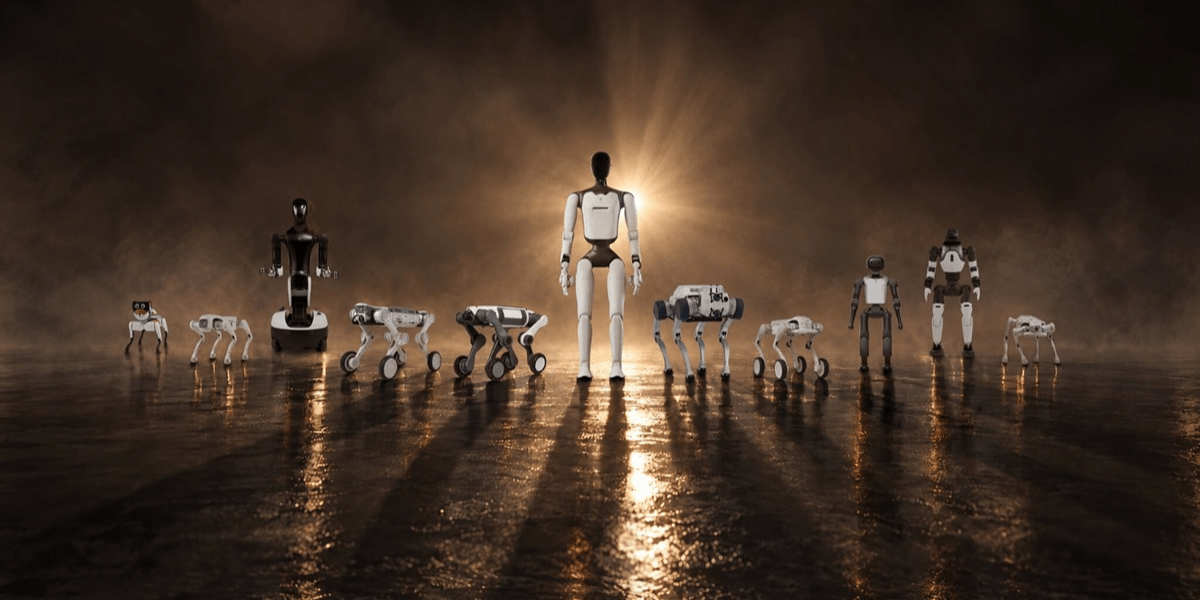
A lineup of various robots standing in a dim, atmospheric setting with glowing light
Faraday Future introduced nine embodied-AI robot configurations and four industry solutions as businesses explore practical physical AI applications.
Robotics Expansion Targets Business Applications
Faraday Future Intelligent Electric launched nine new embodied-AI device configurations and four industry productivity solutions during its 919 event.
The company introduced robotic products across humanoid and wheel-legged formats while also presenting applications designed for K-12 education, research, security and inspection.
The launch represents a broader commercial strategy centered on combining artificial intelligence with physical machines.
For business customers, the development is significant because robotics adoption is moving beyond research laboratories and demonstrations toward specific operational environments.
The challenge for companies is no longer simply whether a robot can perform a task. It is whether the technology can be deployed reliably, integrated with existing operations and produce sufficient value.
Nine New Device Configurations
Faraday Future introduced nine configurations across five models, including the FF All-New Futurist, FF Master Mini, FX Aegis Hyper, FX Aegis Mega and FX Aegis Classic Ultra-W.
The products represent different physical formats and intended applications.
The company's portfolio includes humanoid systems as well as robotic platforms designed for specialized industrial environments.
That range allows the company to approach multiple potential markets rather than depending on one type of robotic hardware.
Different industries have different physical requirements. A security application may need mobility and sensing, while inspection tasks can require specialized cameras, sensors or movement capabilities.
Four Industry Solutions
Alongside the hardware, Faraday Future launched four industry productivity solutions covering education, research, security and inspection.
The move toward industry-specific solutions reflects a wider trend in enterprise technology.
Businesses often prefer technology that addresses a defined operational problem rather than a general-purpose system requiring substantial customization.
Education and research organizations, for example, may have different requirements from security teams or industrial inspection companies.
Providing applications alongside hardware can therefore reduce the amount of work customers need to perform before adopting the technology.
AI Becomes Physical
Artificial intelligence has traditionally been associated with software applications, cloud services and digital platforms.
Embodied AI brings those capabilities into machines capable of interacting with the physical environment.
That transition creates new opportunities but also introduces additional technical challenges.
Robots must operate safely around people, navigate physical spaces, process sensor information and respond to changing conditions.
They also require mechanical components and power systems in addition to computing infrastructure.
The result is a technology category that combines software engineering, artificial intelligence, robotics and manufacturing.
Manufacturing Connection
Faraday Future's robotics initiative is also connected to the broader manufacturing and automation sector.
The company participated in the International Manufacturing Technology Show in Chicago, where it demonstrated robotic systems for security and inspection.
Industrial automation has been used for decades, but advances in AI are creating opportunities for machines to handle more flexible tasks.
Traditional industrial robots are often designed for controlled environments and repetitive processes.
AI-powered systems can potentially operate in less structured settings, although their reliability and commercial usefulness depend on the specific application.
What Businesses Must Consider
Companies considering robotics adoption must evaluate more than the purchase price of a machine.
They also need to consider integration, maintenance, employee training, software compatibility, safety procedures and the availability of technical support.
The business case depends on the particular task.
A robot may be valuable when it can perform repetitive, dangerous or difficult work consistently, but the economics can differ substantially between industries.
That makes industry-specific solutions an important part of the emerging robotics market.
Competition in AI Robotics
Faraday Future's launch comes as numerous technology companies pursue humanoid, quadruped and other robotic systems.
The competitive environment includes established automation companies as well as startups developing new AI-driven platforms.
The market is still developing, and companies are testing different approaches to hardware, software and commercial deployment.
The next stage will depend heavily on whether these systems can move from demonstrations into reliable business operations.
A Growing Enterprise Market
Faraday Future's latest launch reflects a larger shift in business technology.
Artificial intelligence is increasingly being incorporated into physical infrastructure, machines and industrial processes.
The introduction of multiple robotic formats and industry solutions shows how companies are attempting to turn that technological shift into commercial products.
For business leaders, the development raises practical questions about automation, workforce requirements and productivity.
For technology companies, it creates a new competitive field where successful products must combine AI capabilities with dependable physical performance.
The September launch places Faraday Future among companies seeking to build that bridge between artificial intelligence and the physical economy.
Biz Weekly Contributor
Covers business, technology, entrepreneurship, and the changing digital landscape.
This article features partner, contributor, or branded content from a third party. Members of the Biz Weekly editorial staff were not involved in the creation of this content. All views and opinions are those of the contributor alone.