Qualcomm and Amazon Team Up on Next-Generation AI Data Center Technology
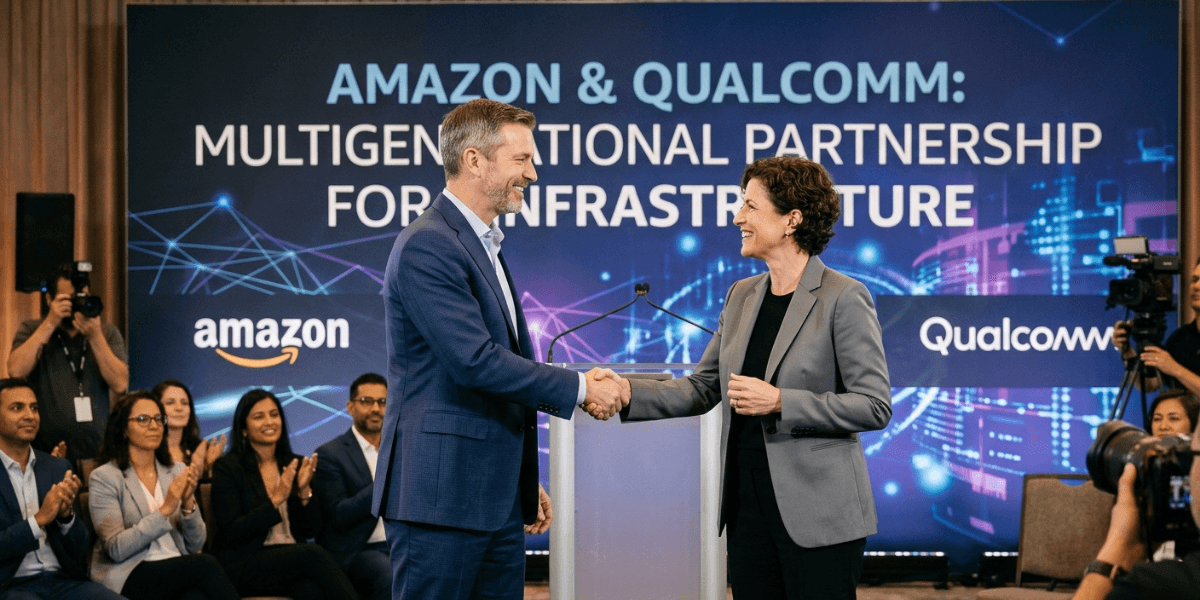
Qualcomm and Amazon announced a multiyear collaboration Tuesday to develop customized chips and optical connectivity technology for Amazon's artificial-intelligence data centers, marking a major expansion of Qualcomm's business beyond its traditional mobile-chip market.
The agreement is aimed at large-scale AI inference and is designed to span multiple generations of customized silicon.
The development comes as technology companies increase spending on computing infrastructure needed to operate increasingly sophisticated AI services.
A New Market for Qualcomm
Qualcomm is best known for semiconductor technology used in smartphones and wireless communications.
The company has increasingly pursued opportunities outside mobile devices, including automotive computing, industrial applications and personal computers.
The data-center market represents another major expansion opportunity.
Cloud computing providers require large amounts of specialized hardware to operate AI systems, creating demand for processors that can deliver high performance while managing energy consumption and infrastructure costs.
Qualcomm's agreement with Amazon places the company directly into that competition.
Amazon Expands Its Chip Strategy
Amazon Web Services has developed its own semiconductor programs as part of a broader strategy to control more of the technology powering its cloud platform.
Custom chips can be designed for particular workloads and integrated more closely with cloud services.
The Qualcomm partnership does not replace Amazon's existing chip efforts. Instead, it adds another technology relationship to AWS's broader infrastructure strategy.
The companies described their arrangement as a multigenerational collaboration, indicating that the partnership is intended to extend across multiple product cycles.
AI Infrastructure Is Becoming a Business Priority
The expansion of artificial intelligence has created enormous demand for data-center capacity.
AI systems require specialized processors, high-speed networking, storage and substantial electrical power.
Cloud providers must therefore make large infrastructure investments to meet demand from businesses and consumers.
The competition is no longer limited to software companies.
Semiconductor manufacturers, cloud providers, networking companies and data-center operators are all becoming increasingly important participants in the AI economy.
The Qualcomm-Amazon agreement reflects that convergence.
Optical Technology Adds Another Layer
The companies also announced plans involving advanced optical connectivity.
Data centers increasingly require high-speed connections between processors because AI workloads can distribute calculations across many computing units.
Moving information quickly between those units can become a major performance consideration.
Optical technology can support high-bandwidth communication within large data-center networks.
By combining customized processors with connectivity technology, Qualcomm is targeting multiple parts of the infrastructure supporting AI workloads.
Implications for Corporate Technology Buyers
The partnership matters to businesses because many companies now rely on cloud platforms for AI services.
Businesses using AWS do not normally purchase the underlying processors directly, but their applications depend on the infrastructure operated by the cloud provider.
Greater competition among semiconductor suppliers could eventually give cloud companies more options for scaling AI capacity.
That could affect performance, availability and the economics of cloud-based computing.
The effect will depend on the technology's eventual deployment and commercial scale.
Qualcomm's Strategic Position
Qualcomm's move into data centers comes at an important time for the semiconductor industry.
Smartphone growth is more mature than it was during earlier periods, while AI has created a new source of demand for advanced processors.
The company is therefore seeking opportunities where its expertise in chip design can translate into other markets.
A relationship with Amazon provides access to a major cloud operator and a large potential deployment environment.
It also places Qualcomm in direct competition with other semiconductor companies pursuing AI infrastructure.
A Broader Industry Shift
The Amazon agreement illustrates how AI is reshaping technology strategy.
Cloud companies want greater control over the hardware supporting their services, while semiconductor companies are looking for growth beyond traditional markets.
The result is a more competitive and diversified AI hardware ecosystem.
For Amazon, Qualcomm provides another source of customized computing and networking technology.
For Qualcomm, Amazon provides a major opportunity to establish a stronger presence in data centers.
The partnership therefore represents more than a single product announcement. It is part of a larger transformation in which AI infrastructure has become one of the technology industry's most important strategic battlegrounds.
Biz Weekly Contributor
Covers business, technology, entrepreneurship, and the changing digital landscape.